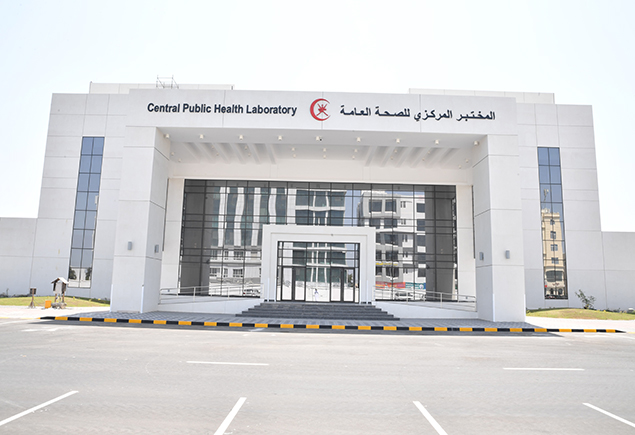
The Ministry of Health will inaugurate the Central Public Health Laboratory in the Wilayat of Seeb, Muscat Governorate, on Monday, coinciding with the anniversary of His Majesty Sultan Haitham bin Tarik, the reins of power in the Sultanate of Oman.
The project was constructed on an area of 18,155 square meters at a total cost of approximately OMR 18.2 million, and is equipped with state-of-the-art technologies and advanced laboratory facilities.
The establishment of the Central Public Health Laboratory comes in implementation of the royal directives of His Majesty the Sultan, in line with technological advancements and modern technical systems, and to enhance readiness to meet public health requirements under all circumstances.
The laboratory will serve as a specialised national centre for advanced laboratory testing, including diagnostic services in virology, bacteriology, chemistry, toxicology, and genetic sequencing. It will also support epidemiological surveillance and outbreak response, strengthening the Sultanate’s capacity to address public health emergencies.
Designed according to the highest biosafety standards, the laboratory includes Biosafety Level 2 and Level 3 laboratories for handling hazardous biological agents. It also features a lecture hall and modern administrative offices that support a productive work environment and facilitate training and capacity-building for health professionals.
The laboratory will function as a national and regional reference centre, providing accurate diagnostic services and supporting disease monitoring and outbreak response programs.
It will play a vital role in developing advanced laboratory capabilities, training national cadres, and enhancing national health security and biosecurity through comprehensive, high-precision diagnostic services.
Its departments will provide specialized and standardised reference testing to support disease prevention, control, and laboratory surveillance, in addition to environmental health and food safety testing.
The laboratory will respond to health emergencies, support health system preparedness, conduct public health and infectious disease research, and ensure quality through national and international accreditation systems.
The laboratory will also manage laboratory information systems, facilitate data exchange and communication, offer training and capacity-building programs for health workers, and promote partnerships and cooperation with national, regional, and international institutions.
Its responsibilities include testing for pulmonary and extrapulmonary tuberculosis, food- and waterborne diseases, and conducting reference tests for expatriate workers. It serves as the national center for antimicrobial resistance, supervises quality control for malaria microscopy diagnostics, and develops national quality assurance programs for public and private laboratories.
In addition, the laboratory prepares and implements specialised training programs for medical laboratory professionals, participates in epidemiological research and studies, and contributes to the training of university students, resident doctors, and health sciences graduates.
The Central Public Health Laboratory is considered one of the leading reference centres in the Eastern Mediterranean Region.
It undertakes regional tasks accredited by the World Health Organization (WHO), including reference laboratories for influenza, polio, measles, and rubella. It is also part of the Middle East PulseNet network and serves as a regional laboratory for bacteriology quality assurance programs. Furthermore, it is designated as a WHO Collaborating Centre for emerging and re-emerging diseases.
The laboratory is equipped with advanced capabilities in molecular diagnostics and genomic surveillance, enabling it to support member states in outbreak preparedness and response, laboratory capacity development, and specialized training. These efforts contribute to strengthening health security and enhancing the efficiency and quality of laboratory surveillance systems across the region.
The building consists of three floors and includes high-security laboratories classified under Biosafety Levels 2 and 3, in addition to specialized laboratories for virology, bacteriology, chemistry, toxicology, newborn screening, genetic sequencing, and bioinformatics. It also houses a lecture hall, library, meeting rooms, and training laboratories to support continuous education and professional development programs.
The Source