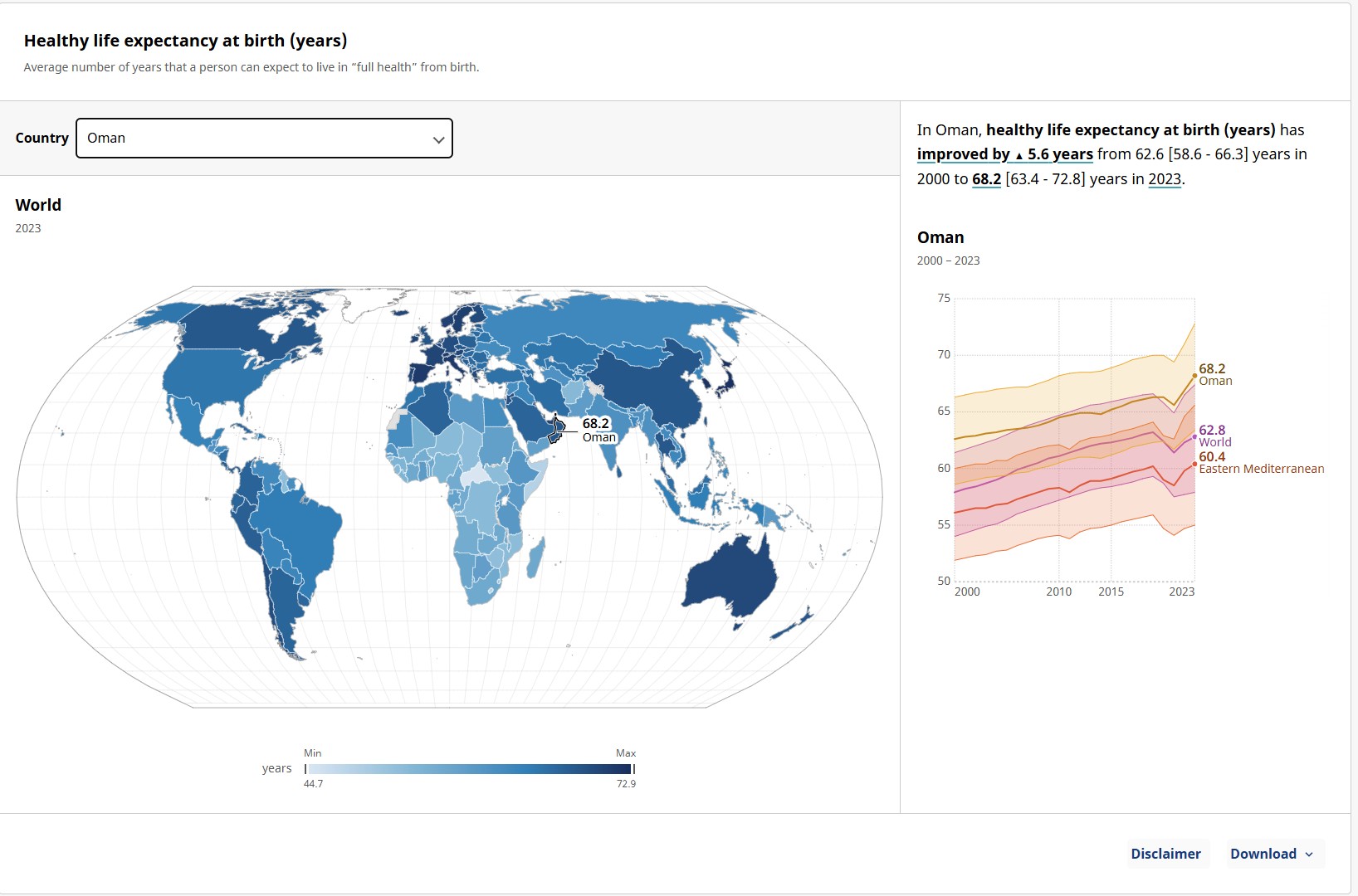
The Sultanate of Oman has achieved a remarkable leap in global health indicators, recording a Healthy Life Expectancy (HALE) at birth of 68.2 years in 2023. According to data published on the World Health Organization (WHO) platform, this represents an increase of five years compared to 63.2 years in 2021.
This figure surpasses the target set by Oman Vision 2040, which aimed for a score of 67 years by 2030 by a margin of 1.2 years. Furthermore, it exceeds the recorded value is now only 1.8 years away from the 2040 target of 70 years.
Oman has also surpassed the global average of 63.8 years by 5.4 years, and the Middle East regional average of 60.4 years by 7.8 years, based on 2023 estimates.
This progress comes during a global post-pandemic recovery phase, a period in which the world has yet to fully regain its pre-pandemic healthy life expectancy levels. In its new estimates released on October 2, 2026, the WHO announced that the global average remains 0.4 years below the pre-pandemic level recorded in 2019. The organization attributed this to the increasing impact of non-communicable diseases and mental health disorders.
It is here that the Omani result gains developmental importance, transcending mere comparative figures. The achievement reflects a strengthened focus on prevention and early detection, reducing years of disability, and improving the quality of treatment, rehabilitation, and integrated care, while taking into account the needs of various groups and regions.
The implications of this indicator highlight the importance of integration between health services and supportive policies for health in education, work, and the urban environment. It also underscores the role of community partnership in protecting these gains by raising health awareness, promoting balanced nutrition and physical activity, avoiding tobacco consumption, utilizing screening services, and monitoring chronic conditions.
Reaching 68.2 years is a milestone that merits highlighting and serves as an incentive to continue investing in human beings. The deepest value of this achievement lies in the years people live in better health, with a greater capacity for giving, and a dignified and productive life.
It is worth noting that the HALE indicator combines both lifespan and health status. It estimates the average number of years a person is expected to live in "full health," adjusted for disease severity and disability. This adds a qualitative dimension to the traditional life expectancy indicator.
The recorded value does not mean every individual will live exactly 68.2 years without illness; rather, it is a statistical estimate at the population level that helps guide policies and agendas. The fundamental message of this indicator is that health progress is also measured by a person's ability to continue an active and independent life and to participate effectively within their family and community.