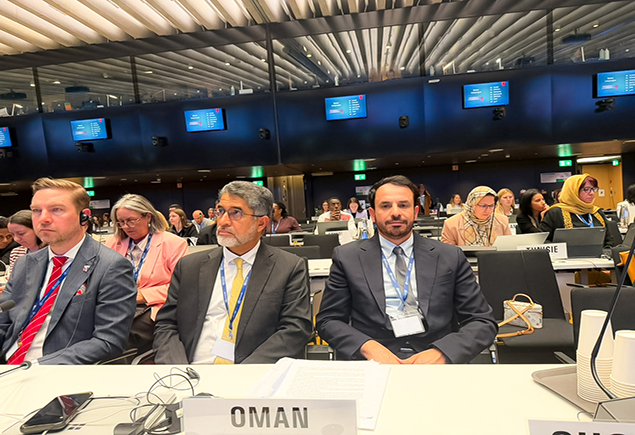
The Sultanate of Oman has reaffirmed its strong support for the adoption of the World Health Organization’s International Pandemic Agreement during its participation in the proceedings of the 79th World Health Assembly (WHA79), held in Geneva from 18 to 23 May.
H.E. Dr. Ahmed bin Salim Al Mandhari, Undersecretary of the Ministry of Health for Health Planning and Regulation, delivered the Sultanate of Oman’s statement before participants under agenda item 13 of the Assembly, relating to the Open-Ended Intergovernmental Working Group on the WHO Pandemic Agreement. He expressed Oman’s appreciation for the intensive efforts undertaken by the World Health Organization and Member States to reach an international consensus on this agreement, including the annex on Pathogen Access and Benefit-Sharing (PABS).
He emphasized that the success of the agreement hinges on ensuring balance and equity in its implementation, in a manner that reinforces the principles of international solidarity and addresses the needs of countries, particularly low- and middle-income countries, in the areas of pandemic prevention, preparedness, and response.
He underscored the importance of respecting national sovereignty and aligning international commitments with national priorities and policies, calling for the provision of technical and technological support and capacity-building to ensure the effective and sustainable implementation of the agreement, without imposing burdens on countries that exceed their capabilities.
With regard to the PABS annex, the MOH Undersecretary emphasized the importance of reaching a practical and balanced framework that facilitates timely and transparent access to pathogens and related data, while ensuring the fair and equitable sharing of benefits, including vaccines, diagnostics, and therapeutics, and taking into account national regulatory and sovereignty frameworks, as well as promoting research and innovation.
He also highlighted the importance of strengthening international cooperation in developing laboratory infrastructure, exchanging epidemiological information and data, and supporting scientific research. He further noted the need to ensure coherence and alignment between the international pandemic agreement and the International Health Regulations (2005), to reduce duplication in implementation.