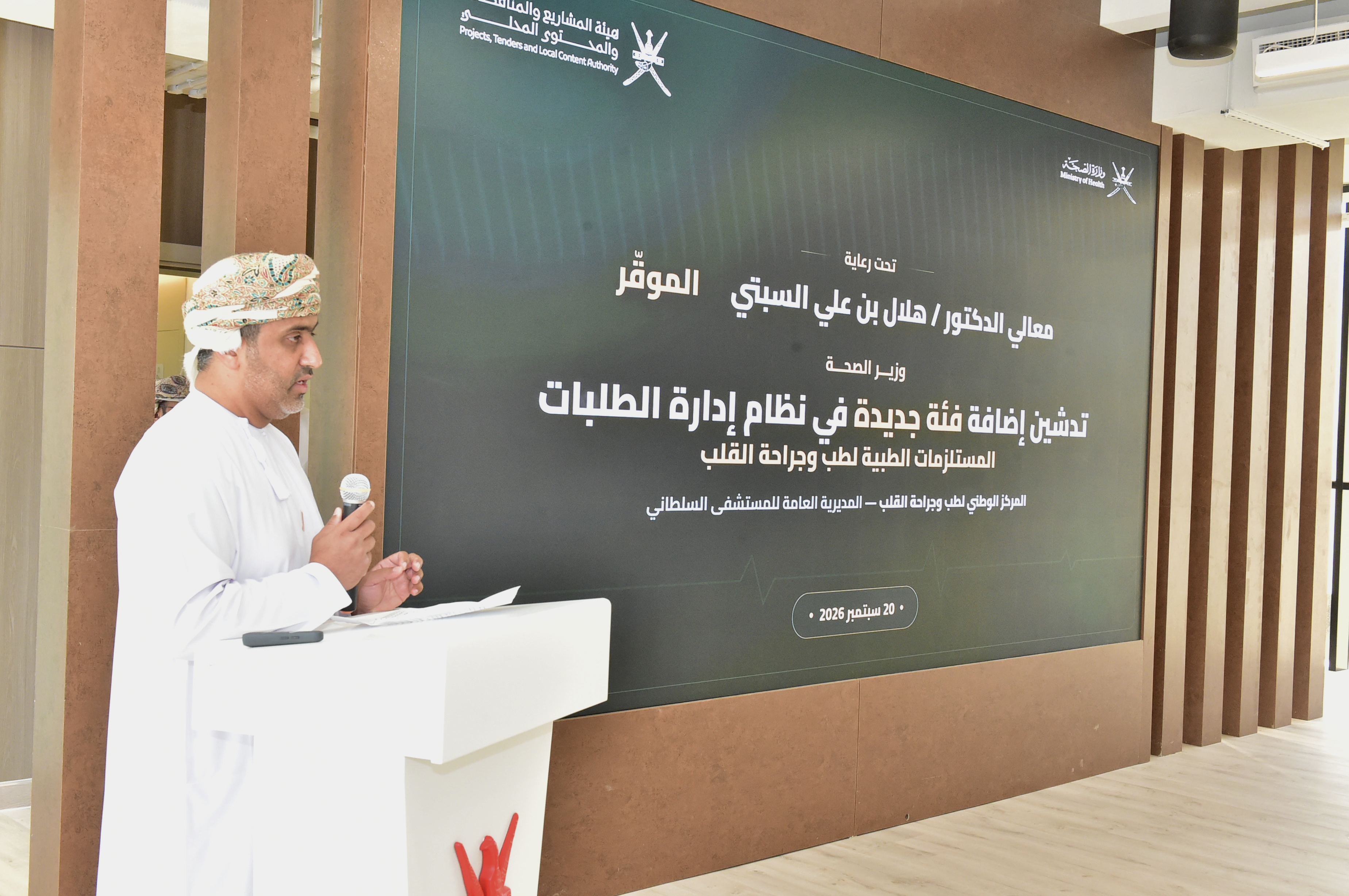
In a strategic step to enhance the efficiency of the health sector and raise the level of medical service quality, Oman’s Projects, Tenders, and Local Content Authority, in cooperation with the Ministry of Health, launched today (Sunday) a new electronic feature via "Amanah" digital platform. This new service is dedicated to supplying advanced medical supplies for the National Heart Center of the Royal Hospital.
The launching ceremony was held under the patronage of His Excellency Dr. Hilal bin Ali Al Sabti, Minister of Health, in the presence of H.E. Engineer Badr bin Salem Al Maamari, Chairman of the Projects, Tenders, and Local Content Authority, and H.E. Sulaiman bin Nasser Al Haji, MOH’s Undersecretary for Administrative and Financial Affairs. Several officials from both sides attended, highlighting the broad interest in developing government procurement mechanisms and accelerating responsiveness to the vital operational needs of the health sector.
This project is a concrete manifestation of the Sultanate of Oman's orientations towards employing innovative digital solutions to develop government procurement systems and smooth transition from traditional procedures to an integrated digital environment managed with the highest standards of efficiency and transparency. The process begins with creating the request and electronically selecting products, passing through the digital approvals chain according to the approved authority matrix, and ending in issuing purchase orders supported by reports and push notifications for all relevant parties.
In this context, Engineer Thamer Al Katheri, Representative of DG Procurement of Government at the Projects, Tenders, and Local Content Authority, confirmed that this initiative serves as a model embodying institutional integration between government entities in Oman. It targets innovation of administrative tools and techniques that effectively contribute to raising general spending efficiency, improving the quality of therapeutic services, and enhancing the sustainability of medical supply chains with high efficiency.
Regarding the operational impact, Al Katheri explained that linking contracts to the Requests Management System has brought about a qualitative leap in reducing the time consumed to complete requests effectively. The procurement cycle, which previously ranged between 45 to 120 days according to previous procedures, has now been reduced to between 24 to 48 hours only. He emphasized that the system allows for covering repeated needs without the need to float new tenders for each request, at stable prices and conditions that ensure the preservation of financial resources and shorten the documentary cycle.
Al Katheri added that the platform currently contains (229) essential products for cardiac surgery supplies, via unified administrative contracts with (23) local suppliers representing the most prominent commercial companies and brands. This grants the National Heart Center broad flexibility and continuity in supply without interruption.
For his part, Dr. Homood Al Kindi, Head of the Cardiac Surgery Department at RH’S NHC and MOH representative in the project, explained that the idea came in response to the rapid development witnessed by the health sector, especially in the field of cardiac and vascular surgery. It aims to build a smart and integrated system for managing medical supplies and materials and supply chains with high efficiency.
He pointed out that the Ministry of Health formed a medical and administrative team comprising specialists in procurement, warehouses, medical supply, contracts, and finance, under the supervision of His Excellency Sulaiman bin Nasser Al Haji, Undersecretary for Administrative and Financial Affairs. The team worked in partnership with the Directorate General of Procurement of Government to develop an early model applied in the Cardiac Surgery Department as a first step towards generalizing it to the medical supply system.
Al Kindi emphasized that this project represents a qualitative leap in procurement and medical supply systems. By shortening procedures and accelerating responsiveness to needs, alongside providing an accurate database that supports proactive planning and budget preparation, it directly reflects on the quality of health and therapeutic services and the achievement of Oman Vision 2040 goals in governance and institutional performance.